
Grandma Earl use to say that one our ancestors was a Regicide Judge that killed the King
- davidsmith208
- Oct 15, 2017
- 6 min read

Such talk I felt was interesting but I asked where is the proof or oh ya who?
It appears she may have been correct though there is some objections of vanity geneology on talk: wikipedia
One should keep in mind that an eleventh generation away includes 2 to the 11th persons or 2048 persons.
I did not like Cromwell's treatment of the Irish and was glad to see that his regiment would have no part in it.
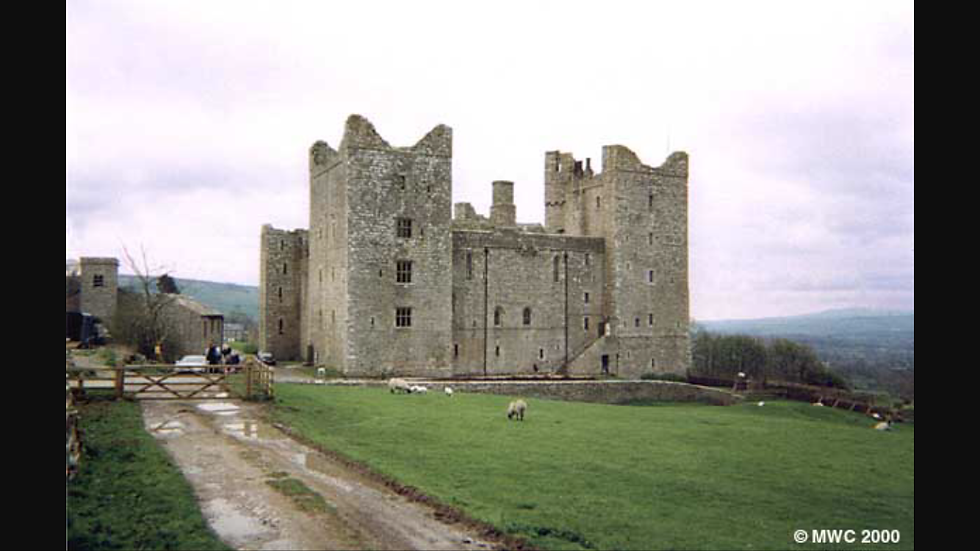
His descendants still own Bolton Castle


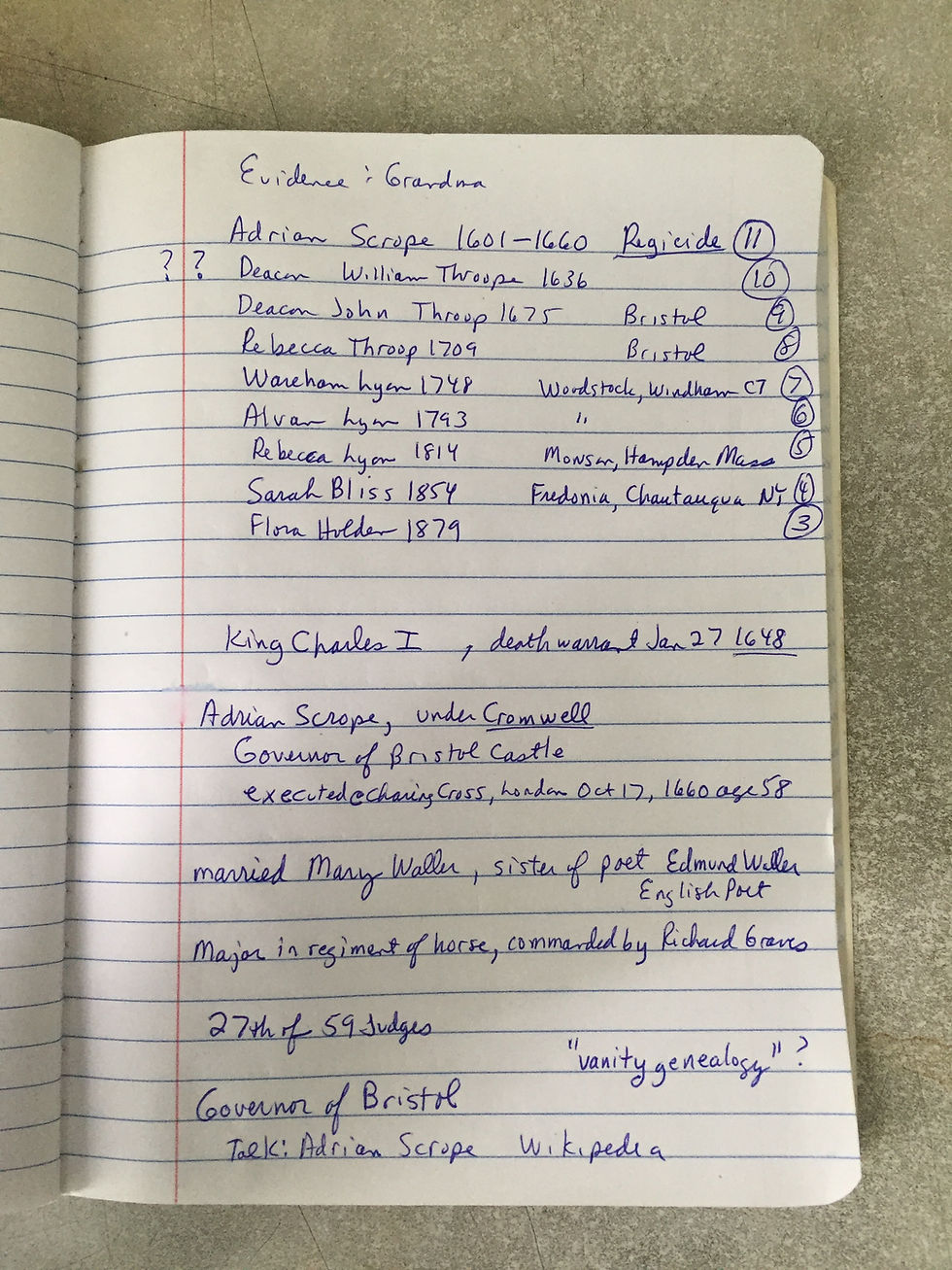


William's last name at birth in England was Scroope. He changed it to William Throope after fleeing to America following his father's execution. After immigrating to the Plymouth Colony he lived in Barnstable, MA and was a grand juryman in 1680. That same year he moved to Bristol, which was then in Plymouth Colony. He was one of the first who settled there after its purchase by four proprietors in Boston. In Bristol he served as surveyor of highways 1683, selectman 1689, grand juryman 1690, and Rhode Islad Assembly Representative from Bristol 1691. He died 4 Dec 1704 and was buried in the East Burial Ground in Bristol, MA. His wife died 6 Jun 1732 and was buried beside him. Widespread belief in the Throop family is corroborated by the Burkes Landed Gentry that Colonel Adrian Scrope, the regicide, who was executed 17 Oct 1660, was his father and his son Adrian insecure in his person and property with the paternal past following him everywhere, fled to Hartford, Connecticut in 1660, and assumed the name of William Throop, to escape pursuit from his father's enemies. Adrian Scrope's descendants are unknown Adrian Scrope's descendants are unknown. It is not even certain how he fits into the Scrope family genealogy (Burke's Landed Gentry 1965 edition and one family website, speculate that he was "Adrian Scrope - born about 12 January, 1600; believed to be the regicide, Col. Adrian Scrope, whose signature is on the death warrant of King Charles". This Adrian was the eldest son of Robert Scrope of Wormesley (b. 1569, himself the eldest son of Adrian Scrope, of Hambleden, co Bucks. The elder Adrian was a younger brother of the Henry Scrope of Spennithorne who was ancestor of the present Scropes of Danby. The possible regicide's sister Anne married her second cousin Henry Scrope of Danby (1605-1642) as his second wife, but the current representation is through her brother-in-law Simon Scrope (1615-1691).) Many persons named Scroop or Throop today claim to be his descendants in the male line. It is not certain why his descendants should have fled to the Americas, however, when those of so many other regicides and Cromwell's own relations remained behind. Mindian (talk)Look at the list of Regicides. You'll see that many of them fled England once Charles II regained the throne. Many that did not were drawn and quartered. Most rational people would avoid that fate. Mindian (talk) 19:17, 15 October 2008 (UTC) The source of this contention is possibly this 90-page book which claims Throop descent from the regicide (and thus also Plantagenetancestry): Knudson, Evelyn Fish, Addison James Throop and Dan Addison Throop. (1943). William Throop and Adrian Scrope - The Family Tradition - History of the Scrope Family and the Barony of Bolton - Bolton Castle - Proceedings at the Trial of Adrian Scrope - The Regicides and the Ancestral Chart of Adrian Scrope, Research and Narrative by Evelyn Fish Knudson. By Addison James Throop and Dan Addison Throop, East St. Louis, Illinois. Privately Printed and published 1943 East St Louis, Illinois. 74-90 pages. Mindian (talk)Descent from royalty and/or nobility is not that uncommon, particularly among colonial Americans. Many of the women marrying into the provable Throop line were descended of nobility/royalty so there would be no need to embellish the Throop genealogy.Mindian (talk) 19:17, 15 October 2008 (UTC) Adrian Scrope (1600-1660) & Margaret Waller (1605-1660) He was believed to be the Regicide (person who takes part in killing a king), Col. Adrian Scrope, whose signature is on the death warrant of King Charles I. Colonel Adrian Scrope was prominent under Cromwell in the Great Rebellion; fought at Edgehill and other battles, was Governor of Bristol Castle, a Commissioner to Scotland, and was appointed one of the High Court of Justice which condemned Charles the First to be beheaded. He attended that Court with exemplary regularity, sat close to Bradshaw, the President, was 37th to sign the death warrant on Jan. 27, 1648. During the political revolutions of 1659-60, he apparently remained neutral and had some prospect of escape at the Restoration of Charles the Second. He surrendered himself in obedience to the King's proclamation; the House of Commons voted he should have the benefit of the Act of Indemnity on payment of one year's rent, but the House of Lords ordered all the King's judges to be arrested and excepted Scrope absolutely from pardon. Later, the Commons reiterated their vote in Scrope's favour, but the Lords remained firm. Taken altogether, this was an inexcusable breach of faith, as Scrope had surrendered in reliance upon the King's proclamation. At his Trial, held at Old Bailey, Oct. 12, 1660, Scrope defended himself with dignity and moderation. He admitted, reluctantly, that he had signed the death warrant of Charles the First. Pleaded that "he was not in the parliament, and that which was done in the high court of justice, it was done by a commission from the parliament, and it was that authority that was then accounted the supreme authority of the nation." Answering this plea, the presiding judge gave an exposition of the British Constitution, showed that the so-called Parliament which had appointed the High Court of Justice was not only unconstitutional but unrepresentative, for "there was but forty-six sat, whereas there were above two hundred and forty excluded," and said : "When men shall assume their acts by obeying them, it is an aggravation." Scrope then pleaded : "If I have been misled, I am not a single person that has been misled, for I see a great many faces that were misled at that time as well as myself," and "I hope that an error of the judgement shall not be accounted an error of the will, for I never went to the work with a malicious heart," to which Lord Chief Barron replied : "If a man do an act of this nature, that may be some kind of excuse to God, but towards man you are to look to the fact." Scrope then reminded the Court that he had surrendered himself on the King's proclamation, but Richard Browne, lord mayor elect of London, in whom "there was great meanness, if not worse," certainly a renegade, for he had been formerly a major-general in the parliamentary army and a kind of a friend of Scrope's, now anxious to prove his loyalty to the new regime, swore that since the restoration of Charles the Second, Scrope had used words apparently justifying the late King's execution and had not pronounced it murder, saying "some are of the opinion, and some of another," and this evidence, which also led to the abandonment of Scrope by the Commons, sealed his fate and he was executed at Charing Cross, London, England on Oct. 17, 1660, aged 58. The Chief Justice, who treated Scrope with great civility and was as just as could be expected at the time, stated : "Mr. Scrope to give him his due is not such a person as some of the rest, but he was unhappily engaged in this bloody business." Noble in his "Lives of the Regicides," states : "It was a thousand pities that if so many were to die as public examples, some of the others were equally guilty of the King's death, and whose lives were a disgrace to any cause, were not substituted in hes stead." Ludlow, a contemporary, said : "His port and mean were noble, and the endowments of his mind every way answerable," and an account of his behaviour in prison and at the gallows describes him as "a comely ancient gentleman," and dwells on his cheerfulness and courage. The night preceeding his death, a nephew came to him in his dungeon and requested him to repent of the part he acted in the King's death, and submit to the present King's mercy, to which he replied, "avoid satan," and this same night he composed himself and "slept so sound he snored." At the gallows he referred to "him through whose means I was brought here to suffer, I say no more, the Lord forgives him, I shall not name him," and in his last prayer, he asked for "strength to stand and endure the present hour of temptation," after which the executioner performed his bloody office. --- The Regicide--ww.scrope.net/ancestors/danby/scrope spennithorn
Comments